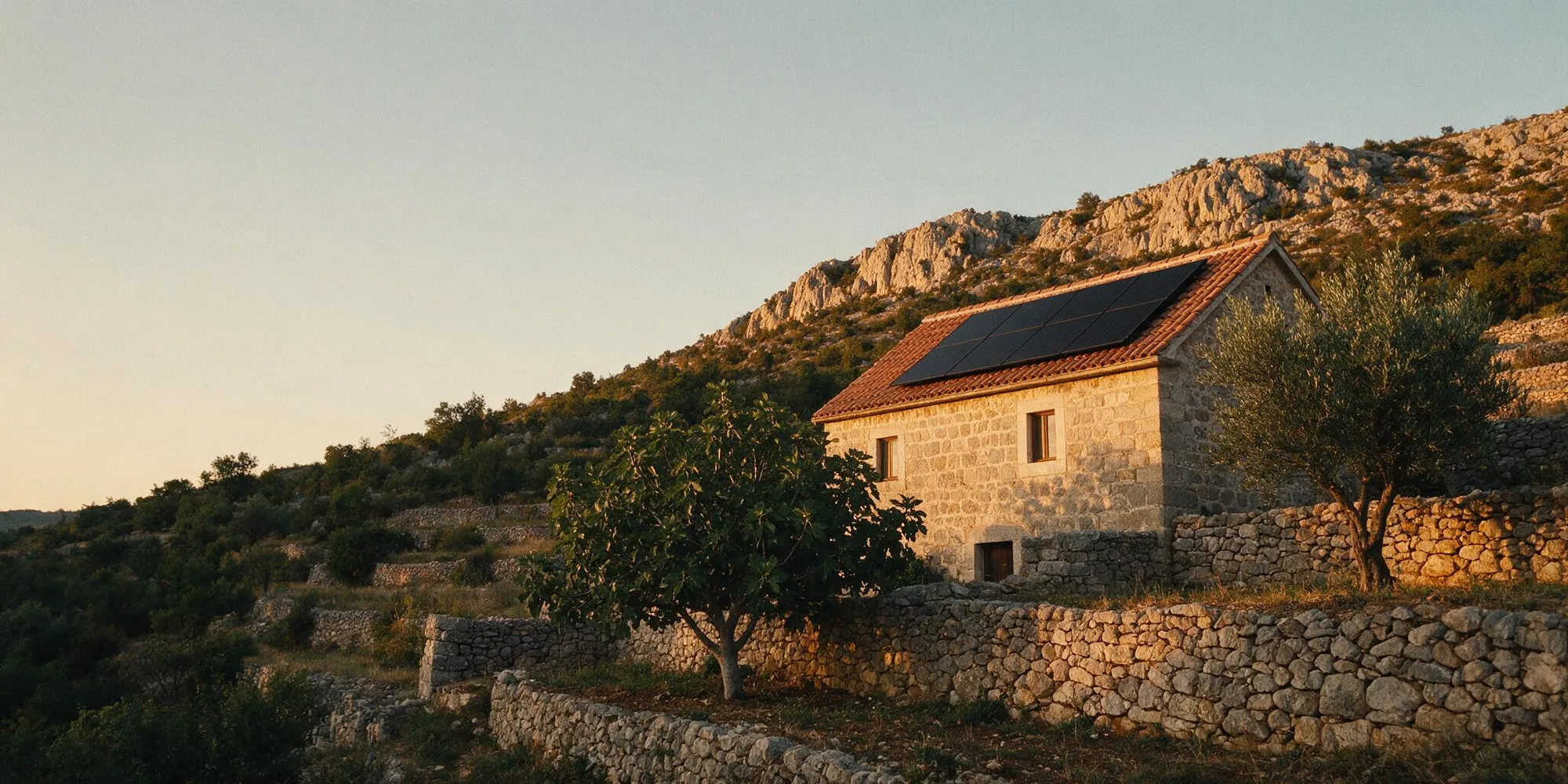
Find out what solar is worth on your roof — before the first phone call
Estimate production and savings for your own roof in two minutes, then compare quotes from vetted installers in your municipality. Free for property owners.
No sign-up. Your phone number is shared only when you choose to share it.
Example: a house in Mostar
6 kW system, pitched roof facing south
Annual production
8,100kWh/yr
Annual savings
1,184KM/yr
Estimated investment
13,800KM
Payback period
12.4yrs
Estimated production by month
Vetted installers across the country
- 1,064–1,373
- Annual yield in BiH
- 12–16
- Typical payback period
- 25
- Panel power warranty
- 58
- Municipalities covered
kWh per kW of installed capacity
for a household using its own output
with 85% of rated output retained
across FBiH, RS and Brčko District
Benefits
What a solar system gets you
A smaller electricity bill
You don't pay for the electricity you produce yourself. For a typical household that means the bill drops to a fraction of today's amount.
5,265kg
less CO₂ per year
Clean energy from your own roof
The grid here still leans on coal. Every kWh from your roof cuts CO₂ emissions directly.
Annual savings
1,184KM/yr
Payback period
12.4years
Property value and predictable costs
Electricity prices keep rising; your output stays the same. The system runs 25 years or more with minimal maintenance.
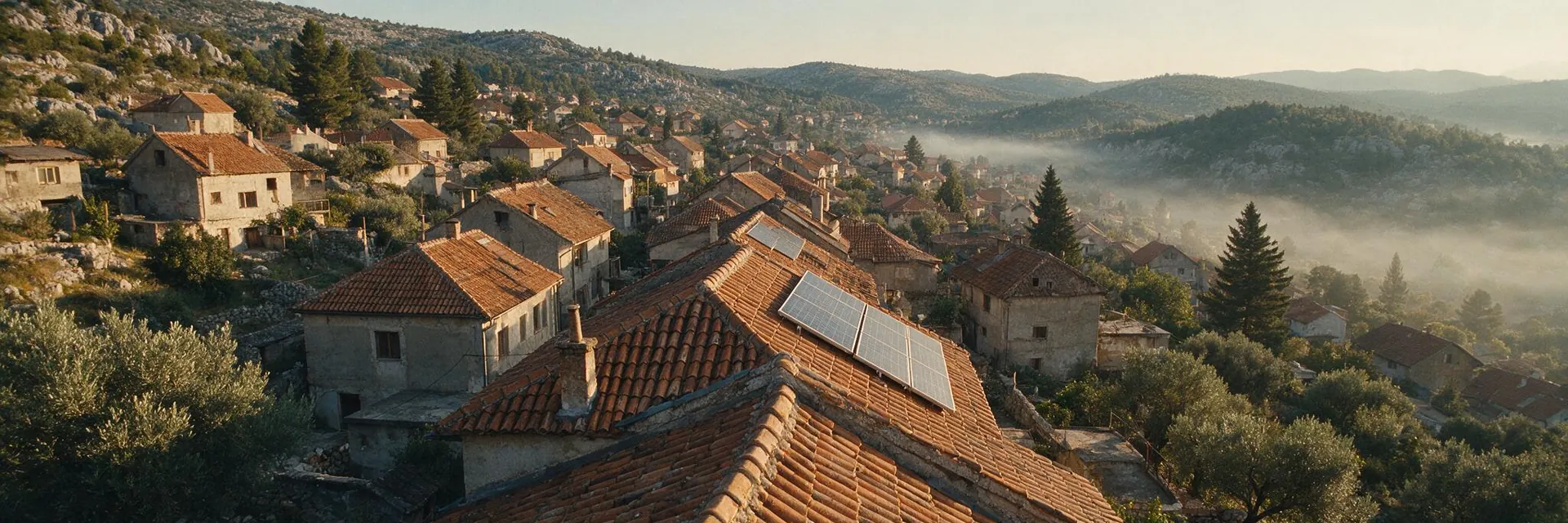
How it works
From estimate to signed contract in three steps
- 01
Run the numbers
Enter your municipality, monthly bill and roughly how much roof you have. You get recommended system size, production, savings and payback.
- 02
Request quotes
We pass one request to installers covering your municipality. Up to three quotes, no pressure and no calls from unknown numbers.
- 03
Compare and decide
Compare price, equipment and lead time in one place. You sign directly with the installer you pick.
Solar potential
Yield varies by region
Herzegovina gets the most sun in the country, but solar pays off in the north too — the difference shows up in the payback period, not in whether it's worth doing.
| Region | kWh / kW per year | Example municipality |
|---|---|---|
| Herzegovina | 1,307 | Trebinje |
| Northern Bosnia and Posavina | 1,158 | Bijeljina |
| Sarajevo area | 1,151 | Vogošća |
| Central Bosnia | 1,149 | Bugojno |
| Krajina | 1,131 | Velika Kladuša |
| Eastern Bosnia | 1,119 | Sokolac |
Customer experiences
What people who have been through it say
Property owners from across the country on how they picked an installer and what they'd do differently.
3
quotes in three days
I put it off for a year because I had no idea even roughly what it would cost. The calculator gave me the ballpark in two minutes and the quotes arrived within three days. The gap between the most and least expensive quote was almost 2,000 KM for practically identical equipment — I only found that out because I had them side by side.
Emir K.Verified
Mostar6.5 kW system
Installer: Installer GKG
−71%
monthly bill
What mattered most was that the estimate wasn't inflated. After the site visit the installer quoted almost the same numbers as the calculator, just slightly better. When somebody promises your bill will drop to zero, you know something is off.
Ivana M.Verified
Banja Luka5 kW system
Installer: Installer PZC
The house is from the eighties and it turned out I needed a new distribution board first. The installer itemised that separately instead of folding it into the solar price, so I knew exactly what I was paying for. I hadn't expected that.
Senad B.Verified
Tuzla7 kW system
Installer: Installer LSK
We publish an experience only with permission, and only after confirming the work was genuinely carried out through the platform.
The platform is in pilot
We don't yet have enough data for a statistic to mean anything. When we do, it will stand here — we're not inventing one in the meantime.
For installers
Qualified leads without a marketing budget
You hear from people who have already sized their system and know the ballpark investment. You pay nothing per request — commission attaches to a signed contract.
- Leads that include location, consumption and roof area
- A company profile with references and price per kW
- No pay-per-click and no exclusivity lock-in
Installer experiences
4 / 11
contracts per lead
We used to get calls along the lines of “how much does solar cost” and spend half an hour on basic education. Now people arrive with an estimate, they know the ballpark, and the conversation starts at the roof and the grid connection. We closed four contracts out of eleven leads in the first three months.
Marko ŠarićVerified
Director, Helios BH
−52%
marketing spend
We were spending on ads and getting leads from all over the country, including municipalities we don't travel to. Here a lead only reaches us if we cover that municipality, so we don't waste time on conversations that go nowhere. We halved our ad budget.
Nemanja VukovićVerified
Co-founder, Krajina Solar
Support
Frequently asked questions
Prices, payback, the rules in FBiH and RS, and how the platform works. If something is unclear, write to us.
What does a solar system cost in Bosnia & Herzegovina?
For households the price runs roughly 2,050–2,600 KM per kW of installed capacity, covering panels, inverter, mounting, labour and paperwork. A typical 5 kW system therefore lands at 11,000–14,500 KM. Smaller systems cost more per kW because fixed costs are spread over less capacity.
How long until the investment pays for itself?
At today's electricity price and full equipment cost, household payback usually runs 12 to 16 years — shorter in Herzegovina and on larger systems, longer in the north and on small ones. Three things shorten it: using more electricity during the day (that output is worth the full retail price), rising electricity prices, and any subsidy you land. Our calculator is deliberately conservative and assumes no subsidy, so real results tend to come out better than shown.
How much electricity can my roof produce?
In BiH one kW of installed capacity yields about 1,150 kWh per year in the north and up to 1,400 kWh in Herzegovina, and needs roughly 5 m² of roof. A 5 kW system on a south-facing pitched roof in Mostar produces about 6,900 kWh a year.
Is my roof even suitable?
The best roofs face south, south-east or south-west with a pitch of 25–35°. East and west give about 13% less but still pay off. North-facing slopes aren't recommended. Flat roofs are fine — panels sit on tilted frames — but need more area because of the gaps between rows.
What happens in winter and when it snows?
Winter output drops to roughly 30–40% of summer levels, because days are shorter and the sun sits lower. Snow on the panels stops production, but on tilted panels it usually melts and slides off within a day or two. What matters is the annual balance: the summer surplus covers the winter shortfall.
Do I need a battery?
For most households here a battery doesn't shorten the payback period yet — it adds a lot to the investment, while the grid already acts as “storage” through surplus crediting. A battery makes sense if you have frequent outages or use a lot of electricity in the evening. The usual advice is to install panels first and add a battery later.
How does net metering work in FBiH and RS?
Both entities have a customer-producer (prosumer) category that may feed surplus into the grid, but the accounting details, the capacity ceiling and the procedure differ between them and have changed in recent years. The practical rule: system capacity is tied to your connection capacity, and surplus is not credited at the full retail price. Your installer confirms the specific terms for your meter with your distribution utility before installation.
What permits do I need?
A typical rooftop system for self-consumption needs a notification to the distribution utility, an energy permit or connection approval, a net-metering contract and a bidirectional meter. Serious installers run the whole procedure for you as part of the quote — check that the paperwork is a line item in the quote and not an extra cost later.
Size your system now
Two minutes, no sign-up. The estimate is indicative; the final price is confirmed by an installer after a site visit.
Open the calculator